Wiggins Group Real Estate Blog

Stay up to date with new listings, open houses and market news

Check out some of our latest activity and circle back to this page for more real estate updates that impact your buying and selling decisions.

RSS

Buying a Court Ordered Sale in BC: How It Works, and What It Really Costs You

Short answer: A court-ordered sale in BC is a home being sold under the supervision of the BC Supreme Court after a lender forecloses. You buy it as-is with no disclosure statement and no cooling-off period, your offer has to be subject-free before it goes to court, and on the morning of the approval hearing anyone can show up with a sealed envelope and outbid you. The discounts are real but usually modest, because the court's job is specifically to make sure the property doesn't sell for less than it's worth. These work well for buyers with cash, flexibility and renovation capacity. They work badly for anyone on a fixed timeline.

There are more of them on the market right now than at any point in the last twenty years, which is why we're writing this.


How many court-ordered sales are there in BC right now?

More than most people realise, though still a small share of the market.

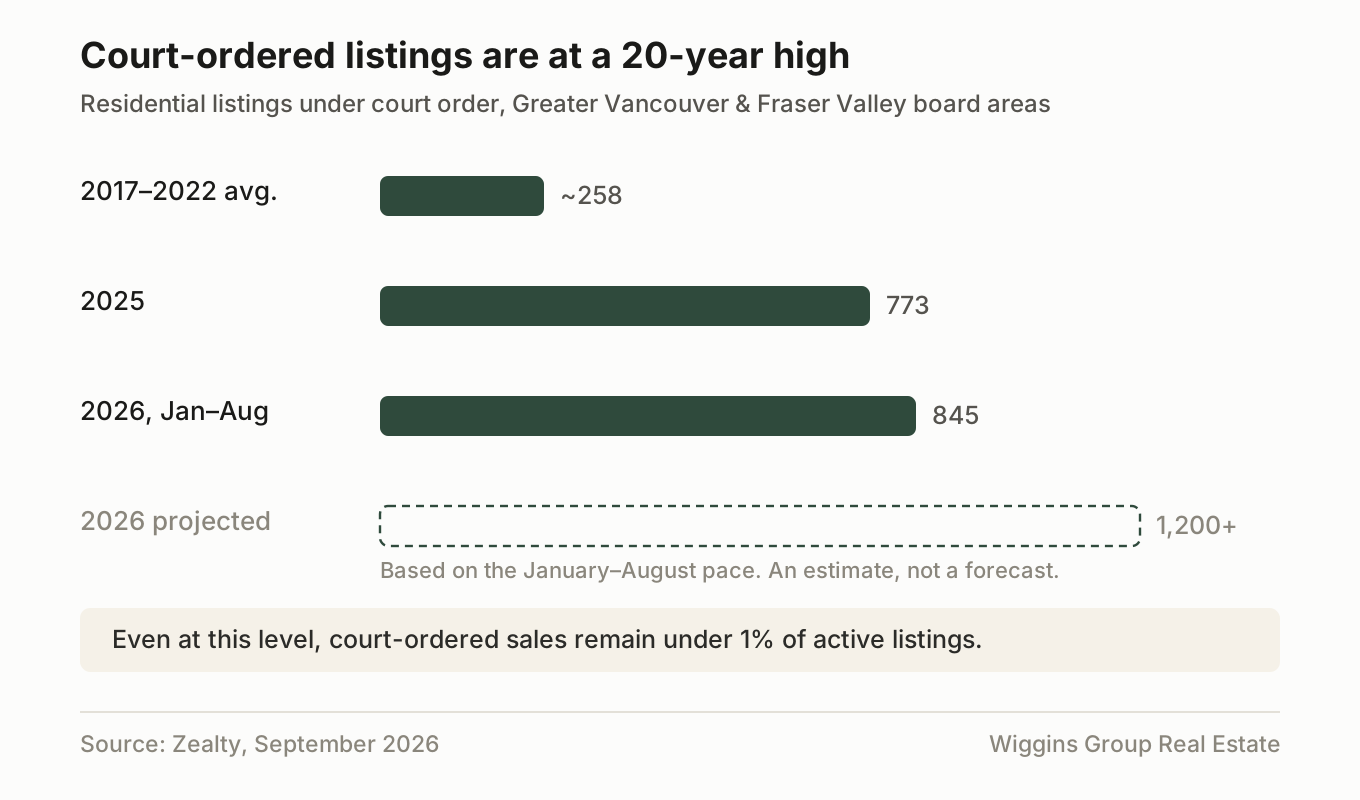
Data from Zealty shows 773 court-ordered listings in 2025 across the areas covered by the Greater Vancouver and Fraser Valley real estate boards — roughly triple the annual average between 2017 and 2022. The first eight months of 2026 alone produced 845, already past the whole of last year. At that pace the year could finish above 1,200 listings, which would be a twenty-year high and would exceed the peak that followed the 2008 financial crisis.

The BC Ministry of the Attorney General has confirmed that the most recent fiscal year hit a ten-year high for foreclosures province-wide.

Two things are worth understanding about this wave. First, it's a lagging indicator — it can take close to a year from a first missed payment to a court-ordered listing, so what you're seeing now reflects financial stress that began well before. Second, it looks different from 2008. Back then court-ordered sales clustered in more affordable areas like the Fraser Valley and the Tri-Cities. This time the activity has shifted up-market, including Vancouver's west side.

Even so, these represent well under one per cent of active listings. This is a real opportunity, not a parallel market.


How the BC foreclosure process actually works

BC does not use power of sale. Everything runs through the Supreme Court of British Columbia, which makes the process slower than in Ontario but considerably more transparent.

1. The lender files a petition

After the borrower defaults, the lender files a petition with the court. The borrower generally has 21 days to file a response.

2. The order nisi

At the first hearing the lender asks for an order nisi — a conditional order of foreclosure. It confirms the default, fixes the exact amount required to redeem the mortgage, sorts out priority among creditors, and sets a redemption period.

Under BC's Law and Equity Act the default redemption period is six months, though a judge can shorten it where there's little equity at stake, or extend it where the circumstances justify more time.

3. The redemption period

This is the borrower's window to fix the situation. They can pay the balance, refinance, or sell the home themselves on the open market. If any of that happens, the foreclosure ends and the property never reaches a court sale.

This matters to you as a buyer. Right up until the court approves a sale, the owner can redeem and the deal evaporates. You can do everything right and still end up with nothing.

4. Conduct of sale

If the redemption period passes without resolution, the lender applies for an order for conduct of sale. This authorises the lender to list and market the property, usually through a realtor, on terms the court sets.

At this point the property appears on MLS like any other listing, typically flagged as a court-ordered sale.

5. Your offer

You write an offer on the standard Contract of Purchase and Sale plus a Schedule A addendum, which is where court-ordered sales diverge sharply from normal transactions. More on that below.

Your offer gets accepted subject to court approval, and all of your own subjects must be removed before the court date. Inspection, financing, title review, strata documents — all done, all at your expense, on a property you do not yet own and may never own.

6. The court approval hearing

This is the part that surprises people.

Your accepted offer is presented to a judge for approval. Under BC Supreme Court Practice Direction PD-66, other buyers may appear at that hearing and submit competing bids in sealed envelopes. They are opened in court that morning.

The judge applies what's often called a providence test — approving the price the court considers fair, and satisfying itself that the sale is provident, meaning it protects the borrower's remaining equity rather than handing a windfall to a bargain hunter.

If a higher bid appears, you can usually improve your offer on the spot. But you're bidding in a room, in real time, against people whose numbers you've just learned.

7. Completion, or an order absolute

Once the court approves, the sale closes much like any other. If no suitable offers come in, the lender can instead seek an order absolute, transferring title to itself.

Typical timeline: roughly three to eight months for the court process, and six to eighteen months from the first default.


What Schedule A actually does to you

This is the single most important document in the transaction, and the one buyers skim.

Sold as-is, where-is. The seller in law is the court, acting through a lender that has never lived in the home and knows nothing about it. There are no representations or warranties about condition, included items, or anything else.

No Property Disclosure Statement. The standard form that tells you about the leaky roof, the buried oil tank or the unpermitted suite simply doesn't exist here.

No Home Buyer Rescission Period. BC's three-business-day cooling-off right does not apply to residential property sold under court order or court supervision. BCFSA confirms this exemption. Once the court approves, you are committed.

Vacant possession is not guaranteed in the way you'd expect. Occupants may still be in the home, and dealing with that can become your problem.

One important limit worth knowing: the as-is clause does not erase a licensee's duty under BC's real estate rules to disclose material latent defects they actually know about. The clause shifts enormous risk to you, but it isn't a licence for anyone to conceal a known serious defect.


The pros

Genuine opportunity in the right circumstances. Properties that need work, unusual properties, or homes with thin buyer pools can trade below what a well-presented equivalent would fetch. The current volume of listings means more of these than there have been in two decades.

Transparency. The process is public and court-supervised. The price has to satisfy a judge. In a normal sale you never learn what the competing offers were.

An unemotional seller. Lenders are not attached to the house and are not negotiating about their children's bedroom. Decisions are commercial.

Less competition from the average buyer. Most buyers won't touch these, which thins the field — though the buyers who remain are usually experienced.

Court oversight cuts both ways. The same process that stops you buying at a steal also means you're unlikely to be caught in a sham transaction.


The cons, including the ones people underestimate

The discount is usually smaller than the folklore suggests. You'll see "10 to 20% below market" quoted widely. Be sceptical. The court's entire function at the approval hearing is to prevent the property selling below fair market value, and competing bidders in the room push the price toward market. Genuine bargains happen where the property is problematic, not simply because it's a foreclosure. Anyone promising you a reliable 20% discount is selling something.

You do the due diligence, then you might lose. This is the real cost. Inspection, appraisal, legal review, strata documents — hundreds or thousands of dollars spent on a property you can lose to a sealed envelope on the courthouse steps. Budget for doing this more than once.

Condition risk is elevated. An owner in financial distress has usually deferred maintenance for a long time. Occasionally a departure isn't gracious. Appliances, fixtures and sometimes worse can be missing. You're buying it anyway.

No disclosure, no recourse, no cooling off. All three protections you'd normally have are gone at once.

The timeline is unpredictable. Redemption can end it at any point. Court dates move. If you need to be in a home by a specific date, this is the wrong path.

Financing can be harder. Lenders are warier of as-is properties, and you need financing firmed up before the court date rather than after. If the home has condition issues, an appraisal may come in short.


Who should actually consider one?

Good fit: buyers with cash or firm financing, flexible timelines, renovation capacity or trades access, and the financial cushion to absorb a surprise after closing. Experienced investors. Buyers who've lost out on a couple and aren't discouraged.

Poor fit: first-time buyers on a tight budget and timeline, anyone who needs to sell an existing home first, anyone without contingency funds, and anyone who'd be emotionally wrecked by losing a home they'd already committed to in their head.

We'd steer most first-time buyers away from these. Not because they can't be done, but because the combination of no disclosure, no rescission period and no margin for a surprise repair is a hard place to learn.


Frequently asked questions

What is a court ordered sale in BC? A property sold under the supervision of the BC Supreme Court after a lender forecloses. Unlike power-of-sale provinces, a judge must approve the sale price.

Are foreclosures cheaper in BC? Sometimes, but less often and by less than people assume. The court's role is to ensure the price is fair to the borrower, and competing bids at the approval hearing push prices toward market value.

Can I put subjects on a court ordered sale? Your subjects must be removed before the court approval hearing. You complete all due diligence at your own expense before you know whether you'll get the property.

Can someone outbid me at the court hearing? Yes. Competing bids may be submitted in sealed envelopes and opened in court on the day. You can generally improve your offer at that point.

Does the cooling-off period apply to a court ordered sale? No. Residential property sold under court order or court supervision is exempt from BC's Home Buyer Rescission Period.

How long does a BC foreclosure take? Commonly three to eight months for the court process, and six to eighteen months from the borrower's first default.

What is an order nisi? The conditional order of foreclosure. It confirms the debt, sets the amount required to redeem, and fixes the redemption period — six months by default under the Law and Equity Act.

Can the owner stop the sale after I make an offer? Yes. Until the court approves, the borrower can redeem by paying what's owed or refinancing, and the sale ends.


If you're facing foreclosure yourself

Some people reading this aren't buyers.

If you've missed payments or received a petition, the most important thing to understand is that the redemption period is genuinely a window, not a formality. Selling on the open market yourself almost always produces a better outcome than a court sale — you keep control of the timing, the price and whatever equity is left.

That gets harder the longer you wait. If you're in that position, talk to a lawyer and get a realistic read on what your home is worth. We're glad to have that conversation with no expectation attached.


Thinking about a court ordered sale?

These transactions reward preparation and punish improvisation. If you want to look at one, we'll walk you through the Schedule A line by line, tell you honestly what we think the property is worth, and give you a realistic view of what it will take to win at the approval hearing — including when we think you should walk away.

We're Denise and Ian Wiggins of Wiggins Group Real Estate at RE/MAX Treeland Realty in Langley, serving Aldergrove, Langley, Surrey, Abbotsford, Mission and the wider Fraser Valley.

604-880-5603 or 604-897-2514 · info@wigginsgroup.ca #101, 6337 – 198 Street, Langley, BC, V2Y 2E3


Foreclosure statistics from Zealty and the BC Ministry of the Attorney General, reported September 2026. This article is general information about the process in British Columbia and is not legal advice. Court procedures and practice directions change — retain a lawyer before making an offer on a court-ordered sale.

Read

Short answer: If you need to move in the next year, list this fall. Sellers have been withdrawing from the Fraser Valley market — new listings in August were down 15% from a year earlier — which means fewer homes competing with yours than in spring, when everyone lists at once. If you genuinely don't need to move and can wait eighteen months or more, waiting is a legitimate choice. What doesn't work is waiting a few months hoping for a better market, because you'd be buying into that same market.

Here's how to figure out which one you are.


What's actually happening with fall listings?

The intuition most sellers have is that spring is when homes sell and fall is when they sit. That's roughly true for buyer traffic. It's not the whole picture.

In August 2026 the Fraser Valley saw 2,373 new listings — down 16% from July and 15% below the same month last year. Sellers are stepping back. Active inventory eased to 9,787, down 3% from July, though still about a third above the ten-year seasonal average.

Meanwhile sales came in at 941, which was 1% above August 2025 — only the second year-over-year gain since the start of 2025.

Put those together: slightly more buying activity than last year, meaningfully fewer new listings. That combination is quietly better for sellers than the headline "buyer's market" suggests.

It is still a buyer's market — the sales-to-active listings ratio was 10%, against 12% to 20% for balanced conditions. But the gap between fall and spring is smaller than most people assume, and the competitive picture may be better.


The spring myth

Spring brings more buyers. It also brings far more sellers.

If you list in April alongside everyone else who spent the winter deciding to move, you're one of a much larger group of similar homes. Buyer traffic goes up, but so does the number of alternatives to your property.

What actually determines whether a home sells is the ratio between demand and competing supply, not the raw number of buyers. A well-priced home in October with fewer comparable listings can outperform the same home in April surrounded by twenty alternatives.

Fall buyers also tend to be more serious. People touring homes in November generally have a reason.


The trap in "waiting for the market to recover"

This is the argument we hear most, and it has a hole in it.

If you're selling and buying — which most sellers are — you don't benefit from a recovery. You sell higher and you buy higher. The two largely cancel out.

In fact, if you're moving up, a soft market works in your favour. A 7% decline on a $750,000 townhouse is about $53,000. An 8% decline on a $1.3 million detached home is about $105,000. The gap you need to bridge has narrowed by roughly $52,000. Wait for a recovery and that advantage disappears.

There's also the rate question. The Bank of Canada has held at 2.25% through six consecutive decisions, and economists surveyed in late August broadly expected no cuts through the rest of 2026, with the next likely move being upward. If you wait a year and prices recover 3% while rates rise, you've gained nothing and possibly lost.


When waiting genuinely makes sense

We'd rather tell you to wait than take a listing that shouldn't exist yet. Wait if:

You don't need to move at all. No job change, no growing family, no financial pressure. A home you're happy in is not an asset you have to optimise.

Your home needs work you haven't done. In a market with this much inventory, a home that shows poorly gets skipped rather than discounted. Six months of targeted work can be worth more than six months of market movement.

You bought recently near the peak and would take a loss you can't absorb. If the numbers don't work, they don't work. Waiting is a real strategy when the alternative is a loss you can't carry.

You're downsizing and can comfortably wait. Downsizers are the one group a falling market genuinely hurts, since your equity drops further in dollar terms than the price of your next home. That deserves its own conversation.


When waiting costs you

You already know you're moving. Every month you delay a decision you've effectively made is a month of carrying costs and uncertainty.

You're moving up. As above — the current spread works for you and will narrow if prices recover.

You're carrying two properties. The math on that rarely improves with time.

It's an estate sale or a separation. Circumstances that need resolution don't get easier by waiting for a season.


What actually determines your result

Not the month. These three:

Price. With inventory this high, an optimistically priced home doesn't just sit — it becomes the comparison that helps a competitor's home sell. Homes priced correctly out of the gate are still moving.

Condition and presentation. Buyers have options. Yours needs to be the one that shows best in its price band, and that's mostly decluttering, minor repairs and good photography rather than renovation.

Realistic expectations about time. Homes are taking longer to sell than they did in 2022. Build that into your plans instead of panicking about it in week four.


Frequently asked questions

Is fall a bad time to sell a house in BC? Not inherently. Fall brings fewer buyers but also fewer competing listings, and fall buyers tend to be more motivated. In the current market, with new listings down 15% year over year, the competitive picture this fall is arguably better than spring's.

Should I wait until spring 2027 to sell my house? Only if you don't need to move, or your home needs preparation work. If you're selling and buying, a market recovery helps you on one side and hurts you on the other.

How long is it taking to sell a home in the Fraser Valley? Longer than in recent years. Check the current FVREB monthly report for average days on market, and plan for a realistic timeline rather than the one you remember from 2021.

Is the Fraser Valley a buyer's or seller's market right now? A buyer's market. The August 2026 sales-to-active listings ratio was 10%; balanced is generally 12% to 20%.

Does listing in December make sense? Rarely. Traffic drops sharply between mid-December and early January. If you're close to that window, either list by late November or plan for a January launch.


Let's look at your specific situation

The right answer here depends on your home, your equity, and where you're going next — not on the calendar.

We're happy to walk through it with you honestly, including telling you if we think you should wait. We'd rather have the right conversation now than the wrong listing in October.

We're Denise and Ian Wiggins of Wiggins Group Real Estate at RE/MAX Treeland Realty in Langley, serving Aldergrove, Langley, Surrey, Abbotsford, Mission and the wider Fraser Valley.

604-880-5603 or 604-897-2514 · info@wigginsgroup.ca #101, 6337 – 198 Street, Langley, BC, V2Y 2E3


Market figures from the Fraser Valley Real Estate Board, August 2026. If you publish after the September report lands in early October, update these. General information only, not financial advice.

Read

Is Now a Good Time to Buy a Home in the Fraser Valley? (August 2026 Update)

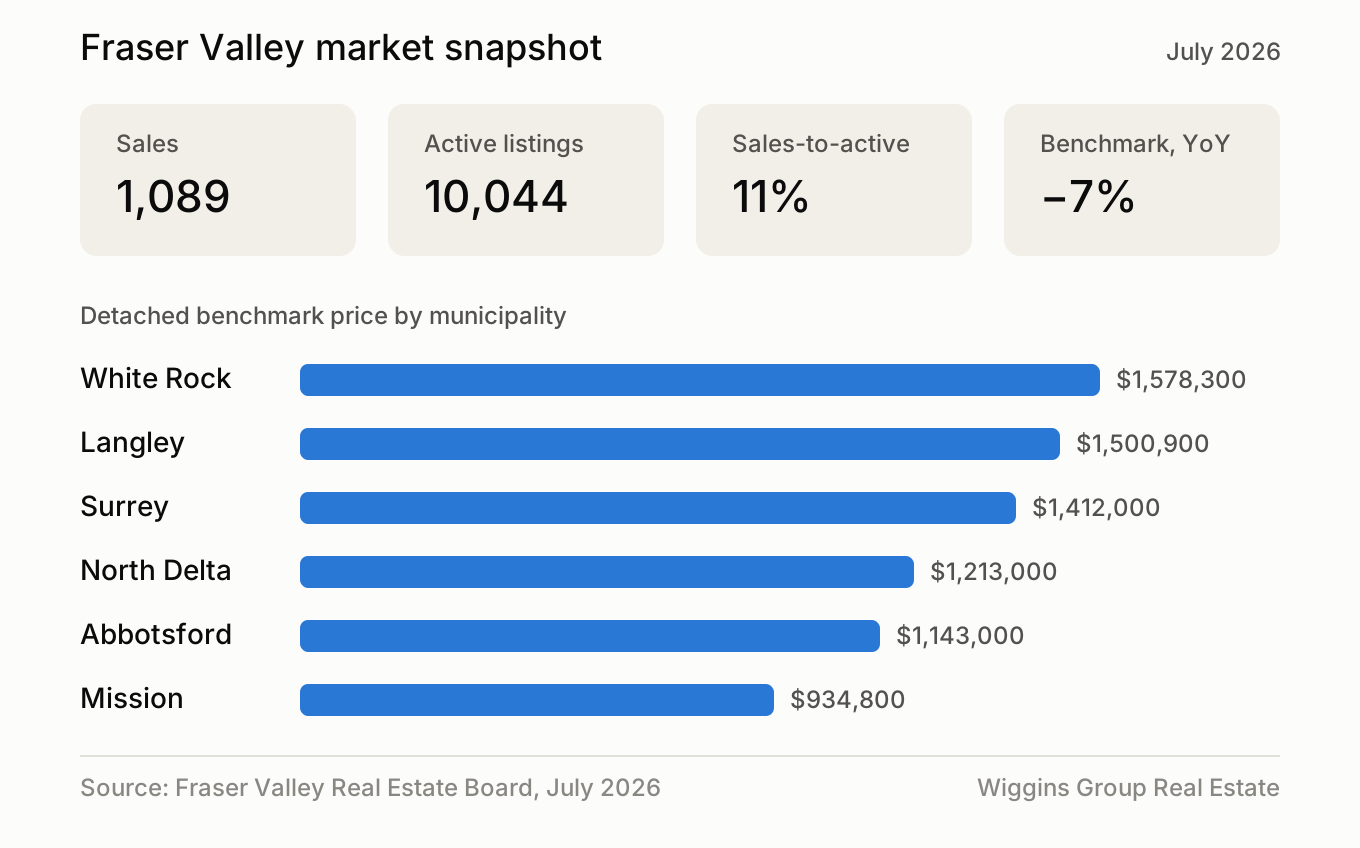
Short answer: For a qualified buyer who plans to stay put for five or more years, yes — this is the strongest negotiating position Fraser Valley buyers have had since 2022. Benchmark prices are down about 7% from a year ago, there were 10,044 active listings on the board in July 2026, and the sales-to-active listings ratio sat at 11%, which is firmly a buyer's market. The trade-off is that mortgage rates are no longer falling, so "waiting for cheaper money" is a weaker strategy than it was two years ago.

Below we break down the current numbers by city, what they mean for buyers and sellers, and the questions we get asked most often at our Langley office.


What is the Fraser Valley housing market doing right now?

The Fraser Valley Real Estate Board's most recent report covers July 2026. Here's where things stand:

Metric (July 2026)NumberChange
Sales1,089Down 5% from June, down 9% from July 2025
New listings2,836Down 14% from June, down 18% from July 2025
Active listings10,044About 32% above the 10-year seasonal average
Sales-to-active listings ratio11%Buyer's market (balanced is 12–20%)
Composite benchmark priceDown 0.8% from June, down 7% year over year

Source: Fraser Valley Real Estate Board, July 2026 Monthly Market Report.

Two things stand out. First, inventory is high but no longer climbing — sellers pulled back in July, with new listings down sharply from both June and last year. Second, buyers are not rushing. Homes are taking roughly 40 days to sell on average, with apartments closer to 46.

That combination is what creates leverage. When a listing sits for six weeks, the conversation changes.


How much have prices dropped in Langley, Surrey, and Abbotsford?

Benchmark prices by municipality, July 2026, with the year-over-year change:

CityDetachedTownhouseApartment
Langley$1,500,900 (−6.2%)$811,400 (−4.8%)$534,200 (−8.9%)
Surrey$1,412,000 (−9.1%)$772,700 (−7.7%)$456,100 (−10.3%)
Abbotsford$1,143,000 (−7.6%)$602,000 (−8.7%)$380,900 (−9.9%)
North Delta$1,213,000 (−9.0%)$848,900 (−8.5%)$496,100 (−10.2%)
White Rock$1,578,300 (−9.5%)$795,900 (−12.6%)$537,700 (−2.7%)
Mission$934,800 (−8.1%)$630,500 (−3.9%)$425,800 (−3.7%)

Source: Fraser Valley Real Estate Board, Municipal Market Report, July 2026. Benchmark price represents a typical home in each category, not an average of sale prices.

For perspective: as of June 2026, Fraser Valley benchmark prices were sitting roughly 26% below their 2022 peak.

A Langley townhouse that would have cost you $852,000 last summer is around $811,000 today. On a 25-year amortization, that difference is real money every month for the next quarter century.


What about mortgage rates? Should I wait for them to come down?

This is the question we get most, and the honest answer is that waiting has gotten riskier.

The Bank of Canada held its policy rate at 2.25% on July 15, 2026 — its sixth consecutive hold. Economists surveyed in late August broadly expect it to stay there through the rest of this year, with the next possible move being a hike rather than a cut. Fixed rates, which follow Government of Canada bond yields rather than the policy rate directly, are currently projected to drift gradually higher rather than lower.

So the strategy of "wait for rates to drop and buy the same house cheaper" no longer has an obvious tailwind behind it. If rates rise while prices flatten out, a buyer who waits could end up paying more per month for the same home.

We're not going to tell you rates will definitely rise — nobody knows. What we will say is that the current window offers something specific and measurable: choice, time, and negotiating room. Those are worth quantifying before you decide to sit it out.


I need to sell before I buy. Am I better off waiting?

Not necessarily, and here's the part sellers often miss.

If you're moving up — say, from a Langley townhouse to a detached home — a falling market usually works in your favour. Yes, you'll likely sell for less than you would have in 2022. But the detached home you're buying has fallen further in dollar terms, because a 6% drop on a $1.5 million house is a much bigger number than a 5% drop on an $811,000 townhouse. The gap you need to bridge has narrowed.

Downsizing runs the opposite way, which is why timing and sequencing matter more for retirees and empty nesters. That's a conversation worth having before you list, not after.

What today's market does demand from sellers is realistic pricing and patience. With inventory 32% above the seasonal norm, an overpriced listing doesn't just sit — it becomes the comparison that helps a competitor's home sell. Homes priced correctly out of the gate are still selling.


Frequently asked questions

Is the Fraser Valley in a buyer's market or a seller's market? A buyer's market. The July 2026 sales-to-active listings ratio was 11%. A balanced market is generally 12–20%, and above 20% favours sellers.

How long does it take to sell a home in the Fraser Valley right now? Roughly 40 days on average for detached homes and townhouses, and about 46 days for apartments, according to the FVREB's July 2026 report.

What is the average price of a house in Langley, BC? The benchmark price for a detached home in Langley was $1,500,900 in July 2026, down 6.2% from July 2025. Townhouses were $811,400 and apartments $534,200.

Are Fraser Valley home prices expected to keep falling? Prices have eased month over month through most of 2026, but the pace has slowed and new listings are declining, which reduces downward pressure. Nobody can forecast this reliably. What's knowable is today's inventory, today's rates, and what a specific home is actually worth.

Which is cheaper, Abbotsford or Langley? Abbotsford, substantially. The July 2026 detached benchmark was $1,143,000 in Abbotsford versus $1,500,900 in Langley — a difference of roughly $358,000 for a comparable typical home.


Talk it through with someone who lives here

We're Denise and Ian Wiggins of Wiggins Group Real Estate at RE/MAX Treeland Realty, a wife-and-husband team based in Langley, BC. We serve Langley, Surrey, North Surrey, Cloverdale, South Surrey/White Rock, North Delta, Abbotsford, Mission, and Chilliwack. Denise was a 2024 FVREB Medallion Club member (top 10% of REALTORS® on the board) and ranked in RE/MAX's top 100 in Western Canada for sales in January 2025.

We're lifelong locals and parents, and our approach is built on clear, honest communication rather than pressure. If you want to know what your specific home is worth in today's market, or what your buying power actually looks like at current rates, we'd be glad to run the numbers with you — no obligation.

Get in touch: 📞 Ian 604-897-2514 Denise 604-880-5603
Email: info@wigginsgroup.ca


Market data in this article comes from the Fraser Valley Real Estate Board's July 2026 Monthly Market Report and Municipal Market Report, and from the Bank of Canada. Chilliwack figures are reported by the Chilliwack and District Real Estate Board and are not included in FVREB statistics. Benchmark prices describe a typical home in each category and are not a substitute for a professional evaluation of your specific property. This article is general information, not financial or legal advice.

Last updated: August 2026.

Read
Reciprocity Logo The data relating to real estate on this website comes in part from the MLS® Reciprocity program of either the Greater Vancouver REALTORS® (GVR), the Fraser Valley Real Estate Board (FVREB) or the Chilliwack and District Real Estate Board (CADREB). Real estate listings held by participating real estate firms are marked with the MLS® logo and detailed information about the listing includes the name of the listing agent. This representation is based in whole or part on data generated by either the GVR, the FVREB or the CADREB which assumes no responsibility for its accuracy. The materials contained on this page may not be reproduced without the express written consent of either the GVR, the FVREB or the CADREB.